
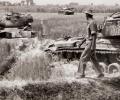
'News is rife that Pakistan will attack the next day. They have no idea that this is where they will take on the might of 1 Armoured Division of Pakistan in a three-day bloody battle that will be remembered in military history as the Battle of Asal Uttar.' Rachna Bisht Rawat salutes the brave men turned the tide of the '65 war.

10 Heroes of the 1965 War which ended on September 23 60 years ago.
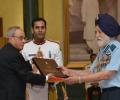
President Pranab Mukherjee on Tuesday hosted a high tea for 1965 war veterans in the Rashtrapati Bhavan complex as the country celebrated the golden jubilee of the war with Pakistan.

'Both Abdul Hamid and the enemy tank place each other in their sights and shoot. Both shells hit their targets. There is a loud blast, fire and smoke.' 'Hamid doesn't get time to jump off. A deafening blast follows and then there is complete silence.' 'Abdul Hamid is dead. He has destroyed a total of seven enemy tanks, many more than what an armoured formation could take on.'
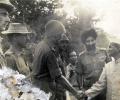
Lieutenant Colonel Desmond Hayde was awarded the Mahavir Chakra, the second highest honour in battle, for winning an epic battle in Pakistan. In a brilliant and gruesome assault, what he and his men achieved that September 50 years ago had never been seen before.
The competition for the worst or most perilous 10 years has always been between the 1960s and the 1980s, points out Shekhar Gupta.

'It was not surprising that joining the armed forces was one of the priority professions that the students strived for. Probably, the training in school helped adjusting to the regimentalised life of the fauj.'
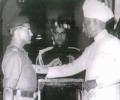
Decorated with a Vir Chakra for leading an attack that destroyed four tanks, Risaldar Ayub Khan shared a name with the Pakistani president who ordered the invasion of India in 1965. India's Ayub came from a family of soldiers and made his country proud.

'Pakistan's recent utterances and tendency to use pinpricks to try our patience appear reminiscent of 1965. We are a strong nation, emerging stronger,' says Lieutenant General Syed Ata Hasnain (retd).

Glimpses of the final days of the 1965 War, as seen from the diary then defence minister Y B Chavan maintained during the war.
